By Nakampe Lekwadu
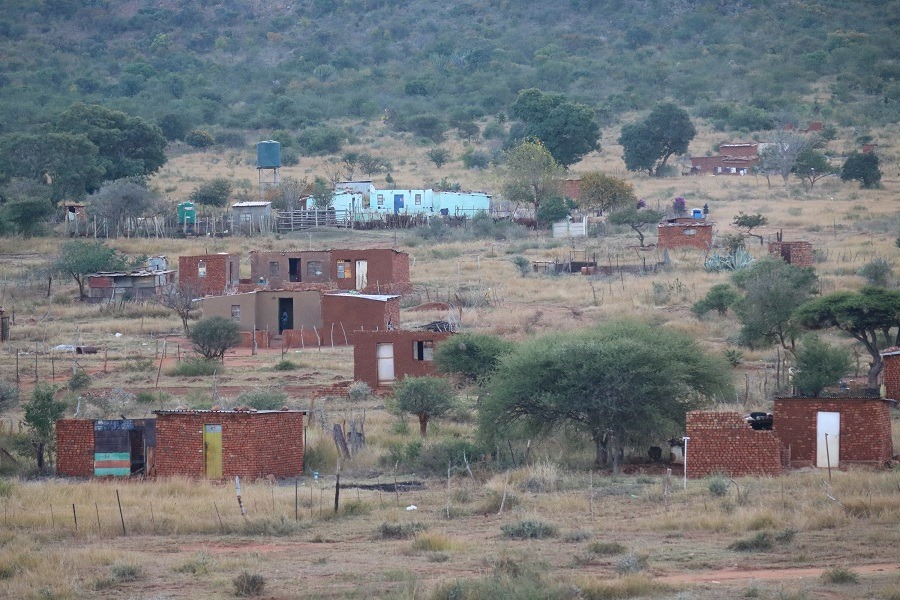
Residents of Matebeleng village, located along the busy N1 highway outside Mokopane in Limpopo’s Mogalakwena Local Municipality, say they are still waiting to enjoy the fruits of democracy more than three decades after the end of apartheid.
Almost 32-years into South Africa’s democracy, Matebeleng remains a visibly poverty-stricken and isolated village, lacking basic services such as proper roads, clinics, RDP housing, sanitation and electricity.
During Lepelle Review’s visit to the area, a 29-year-old resident, Klaas Seolwane, was found sitting next to several two-litre Coca-Cola bottles filled with what he described as “special tea” — a mixture of shrubs collected from a nearby mountain and boiled water. Seolwane claims the concoction helps clean blood vessels and treats various ailments, including prostate cancer.
“We are living in an isolated village where service delivery is just a wishful dream,” said Seolwane. “There are no government facilities or companies here. Finding a job is almost impossible unless you are willing to work as a domestic worker for the handful neighboring white families who often exploit our people.”
He explained that most residents depend on harvesting shrubs from nearby bushes and selling their products to motorists along the national road in order to survive.
Seolwane guided us through a narrow tunnel — only accessible to small single vehicles — which serves as the village’s sole entry point. The gravel road connecting Matebeleng to the outside world is badly damaged and barely passable.
Many residents previously worked at the local brick-making company, Veenen, but their livelihoods were destroyed when the company shut down several years ago, leaving dozens of breadwinners unemployed.
Deeper into the village, a visibly distressed resident, Thomas Moloto, said his stock had just been confiscated by highway patrol officers while he was selling along the freeway.
“Police have warned us many times not to sell on the freeway, and we understand the safety risks,” said Moloto. “We know we could be hit by speeding cars or robbed of the little money we make. But we have nowhere else to sell — that road is our only hope for survival.”
Moloto lives with his five-year-old daughter and claims the child’s mother abandoned them and left the village years ago.
To access basic government services such as clinics, police stations and shops, Matebeleng residents must hitchhike approximately 15 kilometres to Mokopane.
“Hitchhiking on the N1 is extremely difficult,” said 64-year-old Nelson Baloyi, who was born in the village, so as his parents.
“Sometimes you stand there for over an hour. If you’re unlucky, you must walk almost two kilometres to the old road (R101). It’s even worse when you return with heavy groceries.”
Baloyi, an unemployed father of two, said residents have recently received some relief after the local municipality drilled a few boreholes and installed solar panels to supply water.
“We appreciate that initiative. It gives us hope that maybe one day we will receive proper services,” he said.
Before the boreholes were installed, more than 4,000 Matebeleng residents were forced to share water from a natural well with domestic animals. Baloyi also raised concern about frequent snake sightings in the village, particularly during hot summer days and nights, noting that snakes often enter homes.
With no toilets and poor roads, residents say medical emergencies — including snake bites — remains a huge threat.
For 19-year-old Grade 12 learner Moloko Molomo, the lack of electricity poses a major challenge.
“I need electricity to study and charge my phone so I can research and keep up with my schoolwork,” Molomo said. “It’s very difficult, but I have nowhere else to go. My parents and grandparents were born here.”
Molomo attends Veenem High School, while primary school learners are transported to Makapan Valley, approximately seven kilometres away.
“Learners have to walk almost two kilometres just to reach the school bus because there are no access roads,” he added.
Attempts to obtain comment from the Mogalakwena Local Municipality regarding the plight of Matebeleng residents were unsuccessful by the time of publication.